

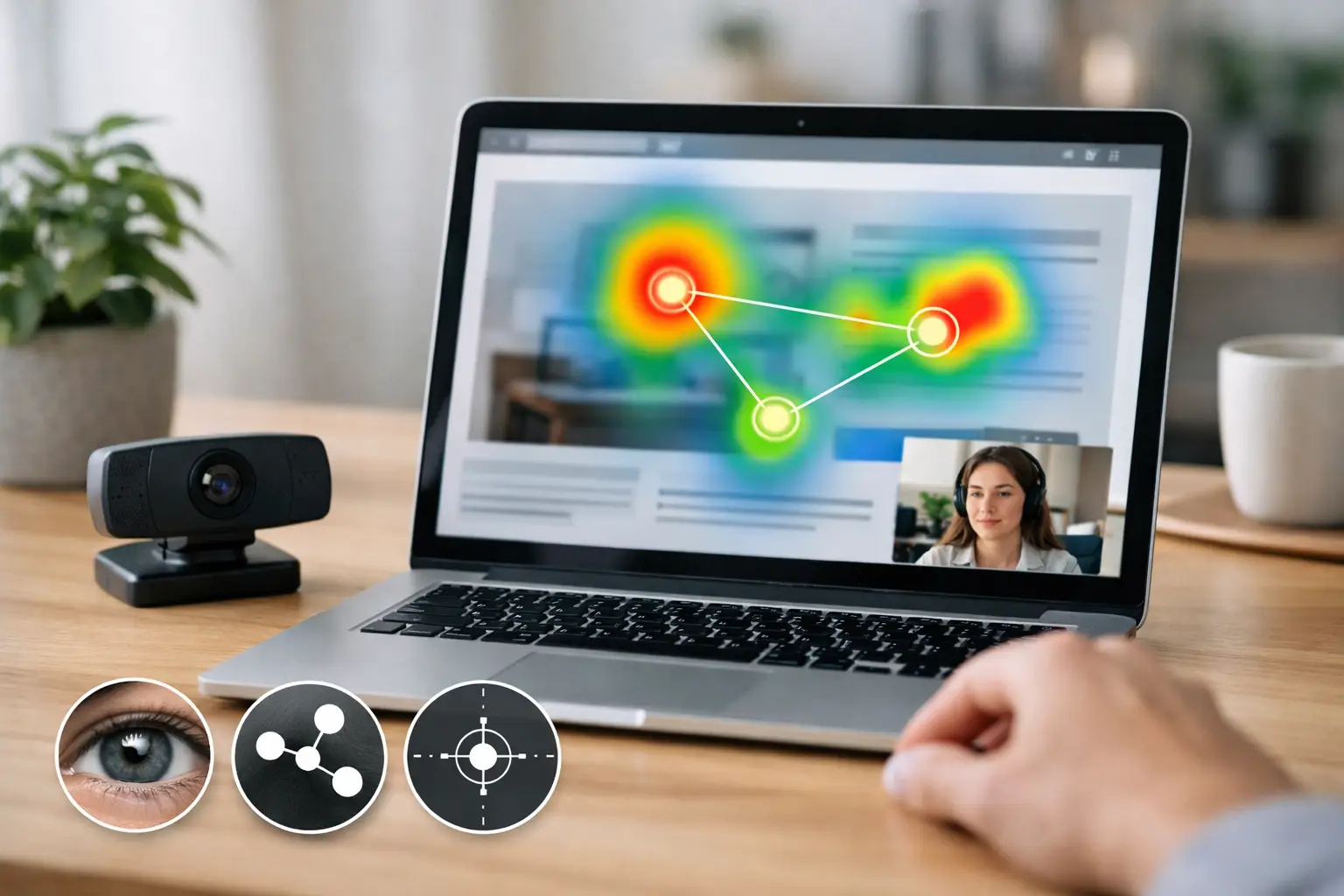
Remote eye tracking is no longer limited to a specialized lab, a hardware shipment, and a small local sample. For UX teams, media researchers, and academic departments, the best remote eye tracking tools can bring attention data into the same online workflow used for surveys, prototype testing, and creative evaluation.
The right choice is rarely the platform with the longest feature list. It is the one that fits the decision you need to make: whether a landing page guides visitors to a CTA, an ad earns attention before branding appears, or package design is visible in a crowded shelf image. The practical question is how quickly your team can set up a valid study, reach the right participants, and turn gaze data into a clear next step.
What makes a remote eye tracking tool worth using?
Remote eye tracking platforms generally fall into two groups. Webcam-based tools estimate gaze through a participant's device camera, making large online studies more practical. Hardware-based systems use dedicated eye-tracking equipment and can provide more controlled measurement, but require more coordination, budget, and participant support.
For many commercial and academic studies, webcam-based research offers the better operational trade-off. Participants can join from home, recruitment can extend beyond one city or lab, and studies can run without equipment logistics. That does not mean every remote use case has the same requirements. Fine-grained research involving tiny on-screen elements, clinical applications, or highly controlled experimental conditions may still call for dedicated hardware.
When comparing platforms, look beyond a heatmap. A useful system should support a complete workflow: browser-based study creation, participant calibration and quality checks, flexible stimuli, survey questions, data exports, and visual reporting that non-specialists can understand. It should also make it clear how data quality is managed when participants use different devices, cameras, lighting conditions, and internet connections.
10 best remote eye tracking tools to consider
1. RealEye
RealEye is designed for teams that need to run webcam-based eye-tracking studies online without building a traditional lab. Researchers can test websites, ads, videos, images, and other media while combining gaze data with surveys, mouse tracking, key tracking, attention measures, and emotion measurement. Heatmaps, fixation plots, dashboards, exports, and API access support both fast stakeholder reporting and deeper analysis.
It is a strong fit when speed, broad recruitment, multilingual studies, and low operational friction matter. Teams can recruit through their own panel provider or use platform-supported panel access, depending on the project.
2. Sticky
Sticky focuses on online attention measurement for advertising, creative, websites, and shopper research. Its offering is geared toward brands and agencies that want to understand what captures attention and what viewers miss across digital experiences.
Consider Sticky when creative effectiveness is the central question and your team wants an attention-focused research partner. Before choosing it, confirm how its study design, recruitment options, reporting depth, and raw-data access align with your internal analysis process.
3. EyeSee
EyeSee combines behavioral research methods with webcam eye tracking and has a strong presence in consumer, retail, and advertising research. Its approach is especially relevant for teams evaluating packaging, shelf displays, digital shopper journeys, and campaign creative.
This can be a good option for organizations that want a managed research service alongside attention measurement. It may be less suitable for teams that need a highly self-serve platform for frequent internal studies, so clarify the expected setup process and project model early.
4. iMotions
iMotions is a multimodal research platform that can bring together eye tracking, facial expression analysis, physiological signals, surveys, and other behavioral measures. It is often used in more complex research programs where gaze is one part of a broader human-behavior dataset.
The advantage is depth. The trade-off is that advanced multimodal research can require more technical planning, training, and equipment integration than a browser-first webcam study. It is best suited to research teams with a clear need for multiple synchronized data streams.
5. Tobii Pro
Tobii Pro is widely known for dedicated eye-tracking hardware and research software. It can support remote or distributed projects when participants use compatible equipment outside a central lab, while preserving a higher degree of measurement control than webcam-only approaches.
This route makes sense for studies requiring precise gaze coordinates, controlled setups, or specialized experimental designs. It also introduces hardware costs, shipping or local setup considerations, and a narrower participant pool. For large, fast consumer samples, a webcam platform may be more practical.
6. Labvanced
Labvanced is an online experiment platform used heavily in academic research. It supports a range of behavioral study designs and includes options for webcam-based eye tracking, making it appealing to universities and researchers who need flexible experiments in a browser.
Its strength is experimental flexibility. Researchers planning complex tasks, randomization, or custom behavioral protocols may find that valuable. Teams focused mainly on marketing creative or website optimization should assess whether the platform's research-oriented interface matches their operational needs.
7. GazeRecorder
GazeRecorder is a browser-based eye-tracking option that can be used for remote studies and visual attention testing. It is often considered by smaller teams, students, and researchers looking for accessible ways to collect webcam gaze data.
It can be a useful starting point for straightforward image, video, or website studies. As with any platform used for business-critical decisions, evaluate participant quality controls, reporting options, support availability, data handling, and how easily your team can export or interpret results.
8. CoolTool
CoolTool offers marketing research services and tools that include online eye tracking and other neuromarketing methods. Its scope can be attractive when a project needs more than gaze data, such as creative diagnostics or shopper-focused behavioral insight.
The key consideration is whether you need a service-led engagement or direct, repeatable access for your own researchers. A managed approach can reduce internal workload, while a self-serve platform gives teams more control over timing, iteration, and study volume.
9. Lumen Research
Lumen Research specializes in attention measurement for media and advertising, with a particular focus on understanding viewing behavior in real-world media contexts. It is relevant for advertisers and media owners seeking evidence beyond impressions, reach, or stated recall.
Choose this type of provider when media attention is the strategic metric and you need a research partner with advertising measurement expertise. For task-based UX testing or rapid product design iteration, a dedicated remote UX research platform may be the closer fit.
10. Attention Insight
Attention Insight uses predictive AI to estimate visual attention from a creative or interface design. It is not participant-based remote eye tracking, but it belongs in the evaluation process because teams often compare predictive tools with live gaze studies.
Predictive analysis is useful for early-stage design reviews, quick variations, and deciding which concepts deserve deeper testing. It cannot replace data from actual participants, particularly when the research question involves task completion, audience differences, emotional response, comprehension, or real interaction with a live website.
How to choose among the best remote eye tracking tools
Start with the decision, not the technology. If you need to improve a checkout flow, choose a platform that can test live web experiences and pair gaze with survey answers or interaction data. If you are evaluating video ads, prioritize support for media playback, timestamps, areas of interest, and audience recruitment. If you are studying package designs, make sure the reporting can compare multiple concepts and show whether brand cues, claims, and key visual elements were actually seen.
Then examine the participant journey. A remote study is only as useful as its data quality. Ask how calibration works, what happens when a participant's camera is not suitable, whether quality thresholds can be set, and how excluded sessions are documented. Also check device support. Desktop-only testing may be appropriate for detailed website work, while mobile-friendly research can be essential for social ads, mobile commerce, and broader consumer behavior.
Finally, consider what happens after fieldwork. Heatmaps are helpful for communicating a pattern, but they are not the entire analysis. Look for fixation and gaze-path views, area-of-interest metrics, participant-level data, filters, survey integration, and export options. The best platform for your organization should let an insights lead answer a stakeholder question without turning every project into a custom analytics exercise.
Use remote gaze data to move work forward
Remote eye tracking delivers the most value when it is built into an iterative research habit. Test the first creative direction before media spend is committed. Review a live page before a redesign becomes expensive. Compare two package concepts before a shelf reset. The goal is not to collect attention data for its own sake, but to make the next design, media, or product decision with stronger evidence.