

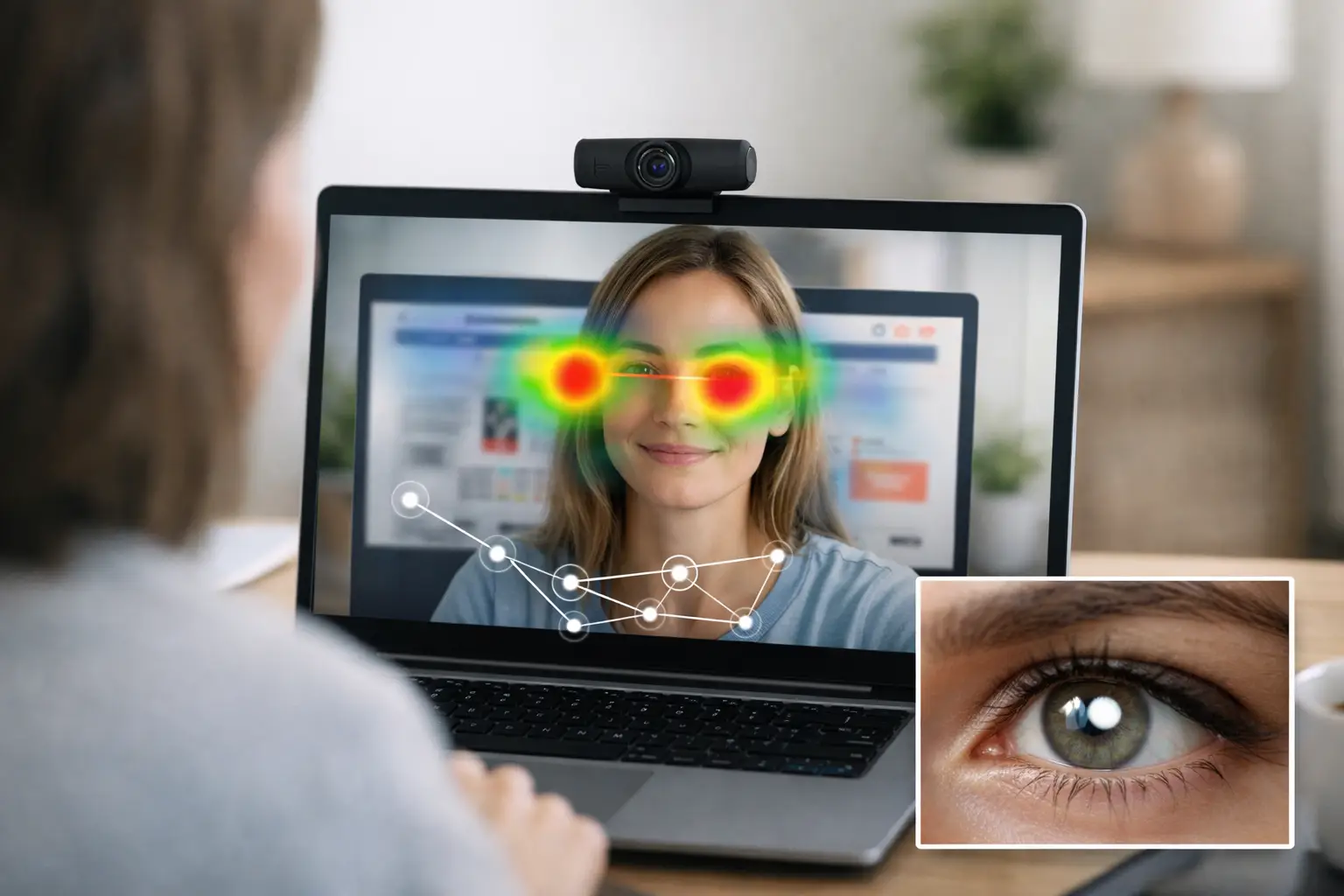
A useful eye tracking accuracy review starts with the decision you need to make, not with a single technical number. If a packaging team needs to know whether shoppers notice a claim, or a UX team needs to see whether users find a checkout button, the research must reliably distinguish meaningful areas of attention. For remote webcam-based studies, that means evaluating accuracy in the context of the screen, stimulus, participants, and question at hand.
Traditional eye tracking has often been associated with controlled labs, specialist hardware, and small samples. Webcam-based eye tracking changes the operational model. It allows researchers to collect attention data through a participant's browser, at scale and across locations. The trade-off is that researchers need to take more care with study design, participant setup, and data-quality review.
What Eye Tracking Accuracy Actually Measures
Accuracy describes how close the estimated gaze point is to where a person is actually looking. It is commonly expressed in visual degrees, although platforms and studies may also discuss screen pixels. A smaller error generally means the system can locate gaze more precisely on the screen.
That definition is useful, but it is not enough on its own. The practical question is whether the expected level of error is small enough to separate the areas of interest in your stimulus. If two navigation labels sit close together, a small positional difference can change the interpretation. If you are comparing attention between a large hero image and a prominent call-to-action, the same degree of error may have little impact on the finding.
Accuracy should also be separated from precision. Precision is about consistency: when someone holds their gaze on one point, how tightly clustered are the estimated gaze samples? A system can be consistently offset from the true point, which indicates good precision but lower accuracy. Both matter because fixation detection, heatmaps, and area-of-interest metrics depend on a stable signal as well as correct positioning.
A third consideration is data availability. Webcam studies can lose samples when a participant turns away, lighting changes, the face is partly obscured, or the camera angle is poor. A study with acceptable accuracy but frequent signal loss may still be unsuitable for fine-grained analysis. Researchers should evaluate accuracy, precision, and usable-data rates together.
Eye Tracking Accuracy Review: Start With the Research Question
There is no universal accuracy threshold that makes every study valid. The right requirement depends on what you want to measure.
For advertising research, researchers often need to establish whether a logo, product, message, or legal disclosure receives attention. These are usually distinct visual areas, making well-designed remote eye tracking highly practical. For website testing, the focus may be on whether users notice a search field, understand page hierarchy, or encounter friction before completing a task. Attention patterns combined with task outcomes, survey responses, and mouse behavior can provide a clear explanation of what happened.
More demanding use cases need greater caution. Reading research involving individual words, interfaces with densely packed controls, and small product labels may require a tighter level of spatial resolution than a remote setup can consistently provide across a broad participant sample. That does not automatically rule out webcam research. It may mean enlarging the stimulus, grouping small elements into a broader area of interest, or using a lab-based method for the most granular question.
The strongest approach is to define your smallest meaningful area of interest before launching. If the study cannot reliably distinguish that area from its neighbors, redesign the visual stimulus or revise the question. This simple step prevents overinterpreting gaze data after collection.
Why Remote Accuracy Varies
In a controlled lab, researchers can standardize distance from the display, lighting, camera position, and hardware. Remote participants bring their own devices and environments. That variety is part of what makes online research scalable, but it introduces variation that should be managed rather than ignored.
Screen size and resolution affect the physical size of an on-screen element. A button that appears generous on a desktop monitor may occupy a much smaller visual area on a laptop. Camera quality, frame rate, glasses reflections, low light, and participant posture can also affect gaze estimation. A participant who leans far to one side after calibration may produce less dependable results than someone who maintains a stable position.
Calibration quality is especially important. Calibration asks the participant to follow targets on screen so the system can map facial and eye features to screen coordinates. A clear, well-paced calibration experience helps participants understand what to do and gives the study a stronger foundation. Validation checks then assess how well that mapping performs.
For this reason, an accuracy claim should never be read as a guarantee that every session will perform identically. It is better understood as a measured capability under defined conditions, with individual results influenced by participant behavior and setup. Quality controls are what make a scalable remote study defensible.
Build Accuracy Into the Study Design
Researchers can improve the quality of a webcam eye-tracking study before the first participant enters. Start with an eligibility check that confirms a supported device, working webcam, and appropriate browser. Give participants simple instructions: sit facing the screen, use normal lighting, keep their face visible, and avoid moving during short viewing tasks.
Use calibration and validation as part of the participant flow, not as a technical hurdle hidden at the beginning. If a participant does not achieve an acceptable result, allow a retry with clear guidance. This is preferable to collecting a full session that later fails quality review.
Stimulus design matters just as much. Make key areas large enough for the decision being tested. Avoid treating borders between adjacent elements as decisive when the expected gaze error could reasonably cross them. For a mobile creative, evaluate the product, brand, offer, and call-to-action as purposeful regions rather than making claims about a tiny icon.
Timing also deserves attention. Very short exposures can answer questions about first impressions, but they leave less room to recover from a missed sample or momentary tracking interruption. Longer free-viewing tasks reveal broader attention patterns, yet may be affected by distraction. Match exposure duration to the behavior you are trying to observe.
Review Quality Before Reading the Story
A good analysis workflow separates data-quality checks from interpretation. Review calibration and validation outcomes, tracking availability, session duration, and signs that a participant did not follow the task. Then establish inclusion rules before comparing variants or reporting results.
The rules should fit the study. A fast creative test may exclude sessions with substantial tracking loss and retain participants whose data meets a predefined quality bar. A usability study may additionally require task completion, reasonable task duration, and evidence that the participant engaged with the page. Consistency matters more than choosing an arbitrary rule after seeing the results.
Once quality criteria are applied, use multiple views of the data. Heatmaps show where attention concentrates across a group, while fixation plots help reveal sequence and individual behavior. Area-of-interest metrics can quantify time to first fixation, whether an element was seen, dwell time, and revisits. Survey answers, clicks, mouse movement, and task success add the context that gaze alone cannot provide.
For example, a call-to-action with low attention and low click-through is a strong signal to investigate placement, contrast, copy, or competing content. A call-to-action with low attention but high conversion may be sufficient for returning users who already know where to go. The metric is a prompt for a decision, not a verdict detached from user behavior.
Validate the Method for High-Stakes Work
When findings will influence a major campaign, product release, or academic claim, plan a validation step. Test representative stimuli with a pilot sample and inspect whether the system distinguishes the areas that matter. Compare expected behavior with observed gaze patterns. If participants are asked to find a prominent price, for instance, their fixations should generally align with that location rather than drifting unpredictably around the page.
For some projects, comparing a remote study against a controlled reference method can be useful. The goal is not necessarily to produce identical fixation coordinates. It is to determine whether both methods support the same practical conclusion, such as which design attracts attention first or whether a key message is missed. Agreement at the decision level is often more valuable than a theoretical comparison of isolated points.
RealEye supports this workflow in a browser-based environment, combining webcam eye tracking with surveys, attention measures, mouse and key tracking, visualizations, exports, and recruitment options. That combination helps teams assess attention alongside the behaviors and responses that explain business impact.
Make Accuracy Useful, Not Abstract
The best remote eye-tracking studies do not chase a headline accuracy number without context. They define what must be distinguishable, design stimuli accordingly, guide participants through calibration, apply transparent quality criteria, and interpret gaze alongside other evidence.
That approach keeps the focus where it belongs: on making a confident research decision. Start with a pilot, inspect the data before scaling, and let the required level of accuracy be set by the real visual choice your audience needs to make.