

A strong creative concept can still underperform if people miss the brand, misunderstand the message, or lose interest before the key moment. The top creative testing methods help research and marketing teams see where that breakdown happens before a campaign reaches a larger, more expensive audience.
Creative testing is most useful when it answers a decision, not when it produces a stack of scores. Is the product visible soon enough? Does the call to action arrive at the right time? Are viewers reacting to the intended message? The right method depends on the format, the decision at stake, and whether you need to understand stated opinion, observed behavior, or both.
Start With the Decision, Not the Method
Teams often begin with a favorite metric: recall, preference, click-through rate, or attention. That can create a study that is technically sound but not especially useful. Start by defining the action the results should support.
For example, an early-stage concept review may require feedback on relevance and emotional tone. A near-final video ad may require evidence that viewers notice the logo and product claim. A packaging refresh may require proof that shoppers can find the brand and variant quickly in a crowded shelf. These are different questions, so they deserve different testing approaches.
A practical creative testing plan also separates diagnostic questions from go-or-no-go questions. A benchmark score can identify a likely winner. Diagnostic evidence explains what to change when none of the options is strong enough.
Top Creative Testing Methods for Different Questions
1. Concept and message testing
Concept testing evaluates the core idea before a team invests in final production. Participants may review a written proposition, storyboard, static mockup, or animatic and respond to questions about clarity, relevance, uniqueness, credibility, and purchase intent.
This method is efficient for comparing several directions early. It helps teams avoid spending production budget on an idea that sounds clever internally but feels generic or confusing to the intended audience. Open-ended responses are particularly valuable here because they show how people describe the message in their own words.
The trade-off is that concepts are not finished ads. A participant may understand a message in a written board but fail to notice it once music, editing, product shots, and competing visual details are introduced. Use concept testing to select a direction, not to certify final execution.
2. Survey-based copy and creative evaluation
Structured surveys are a flexible way to test static ads, social assets, email creative, display units, landing pages, and campaign variations. They can measure perceived relevance, comprehension, appeal, brand fit, credibility, motivation, and stated likelihood to take action.
This approach works well when teams need directional feedback from a defined audience and want to compare multiple executions quickly. It is also useful for message hierarchy: show an ad briefly, then ask what participants remember, what they believe the main takeaway was, and what brand they associate with it.
Survey results should not be treated as direct evidence of in-market behavior. People are generally better at reporting what they think about a creative than explaining where their eyes went or why they missed a visual cue. Pair surveys with behavioral measures when visibility and attention are central to the decision.
3. Remote eye-tracking
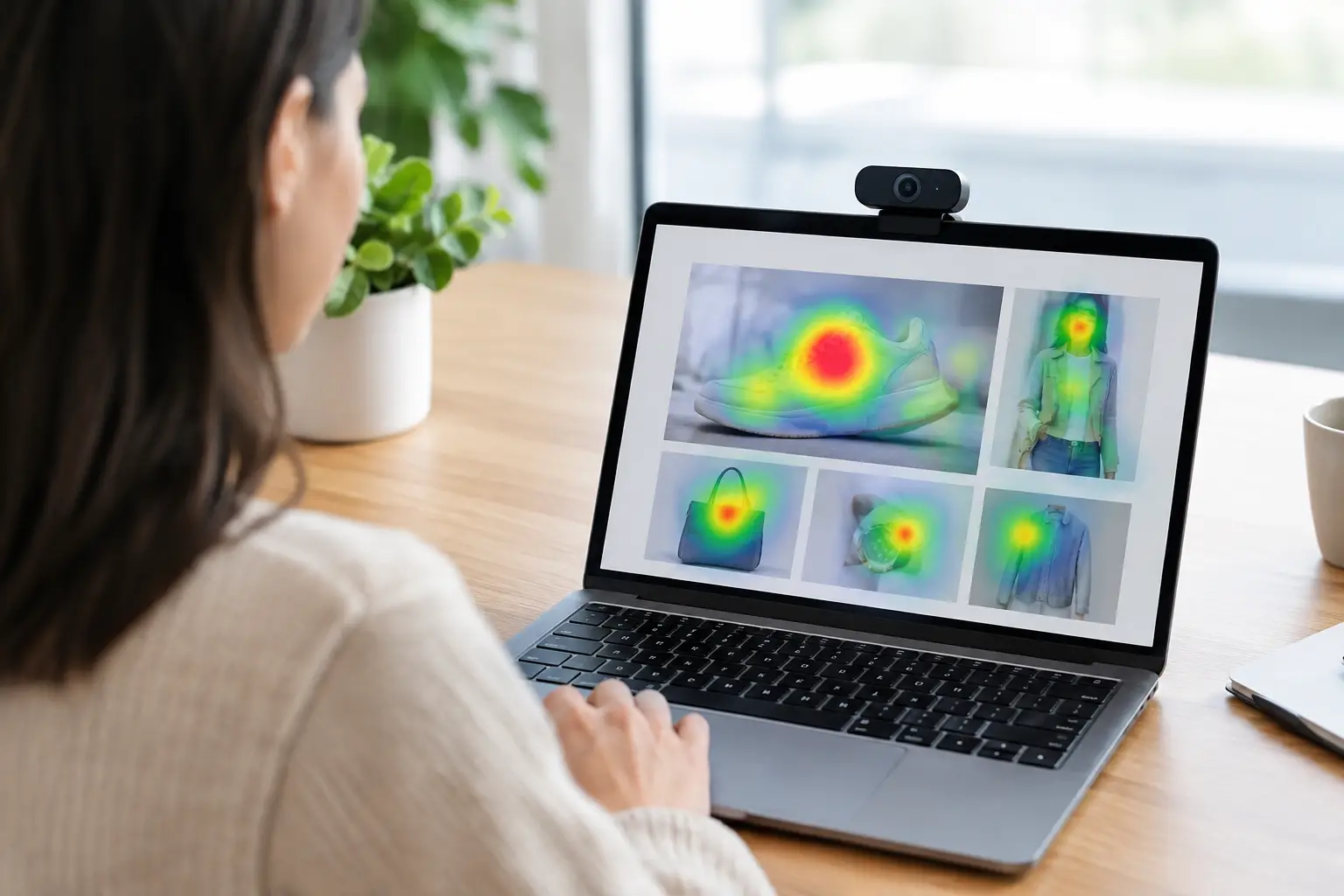
Remote eye-tracking measures what participants actually look at while viewing creative, browsing a website, watching video, or completing a task. It can reveal whether attention reaches a logo, product, price, headline, disclaimer, button, or other area of interest - and when that attention occurs.
For advertising teams, this is especially useful when an asset contains many competing elements. A heatmap can show where attention concentrates across participants. Fixation plots can help explain viewing order. Time-based results can identify whether a brand appears before viewers disengage or whether a key claim is noticed only after the most persuasive visual moment has passed.
Webcam-based research makes this method practical for remote studies, including geographically distributed audiences. With a platform such as RealEye, teams can combine eye-tracking with surveys, mouse tracking, and task-based research in a browser-based workflow.
Eye-tracking does not tell you whether participants liked what they saw. Attention is not the same as positive response, comprehension, or intent. Its value is diagnostic: it provides evidence of exposure and visual behavior that can be interpreted alongside survey responses and performance data.
4. Facial expression and emotion measurement
Emotion measurement can help researchers understand the moment-to-moment response to video, interactive content, and other dynamic experiences. It is often used to identify where interest rises, where confusion or frustration may appear, and whether a key scene produces the intended emotional reaction.
This method is most useful when paired with the creative timeline. If attention drops during the product demonstration and self-reported interest declines after it, the team has a clear section to investigate. If viewers show a positive response but cannot later recall the brand, the issue may be branding integration rather than the emotional quality of the story.
Treat emotional signals carefully. A visible expression is only one indicator and can vary by individual, culture, viewing environment, and calibration quality. It should support interpretation rather than replace direct questions about what people felt and why.
5. A/B testing in live media
Live A/B testing compares creative variants using real campaign performance. Depending on the channel, teams may evaluate click-through rate, conversion rate, cost per acquisition, video completion, engagement, or downstream outcomes such as qualified leads.
The major advantage is realism. People encounter the creative in the context where it will compete for attention, and results are tied to actual behavior rather than hypothetical intent. This makes A/B testing highly valuable for final optimization, especially when the decision concerns copy, thumbnails, calls to action, offers, or landing-page variations.
Still, live performance can be difficult to diagnose. An ad might win because of audience targeting, delivery conditions, placement, frequency, or an unusually strong offer rather than the creative itself. Control what you can, use sufficient sample sizes, and avoid declaring a winner based on a short-term fluctuation.
6. Usability testing for landing pages and interactive creative
When creative leads to a website, product page, configurator, or interactive experience, usability testing closes the gap between ad response and conversion. Give participants a realistic task, such as finding product details, comparing options, or starting a trial, then observe where they hesitate or abandon the journey.
Screen recordings, mouse movement, key tracking, surveys, and eye-tracking can all contribute useful evidence. A landing page may receive strong ad traffic while still underperforming because visitors do not see the price, mistake a promotional banner for navigation, or fail to recognize the next step.
This method works best with task scenarios that reflect real intent. Asking participants to freely browse can generate broad impressions, but it often misses the friction that matters when someone is trying to complete an action.
Build a Testing Sequence That Matches Production
The most efficient programs do not rely on one large study at the end. They use progressively stronger evidence as creative becomes more expensive to change. Early concept work can rely on qualitative feedback and survey comparisons. Storyboards and rough cuts can add message recall and emotional response. Final assets can be tested for attention, comprehension, and usability. Live experiments can then optimize the remaining variables in market.
This sequence protects speed without treating speed as a substitute for learning. It also reduces the common problem of discovering a visibility issue after media has launched, when the only practical fix is to buy more impressions.
Make Results Easy to Act On
Creative research becomes useful when findings translate into specific changes. Instead of reporting that an ad has “low attention,” identify the element, time window, audience segment, and likely design cause. For example: the product pack receives limited fixation during the first five seconds because the presenter and animated text compete for focus. That finding suggests an editable action: enlarge the pack, simplify the background, or introduce it earlier.
Prioritize issues by expected impact. A missed legal line may require a compliance revision. A late brand reveal may affect recall across the entire campaign. A minor color preference may be worth changing only if it can be adjusted without disrupting a better-performing message hierarchy.
The best creative testing program is not the one with the most metrics. It is the one that gives your team enough reliable evidence to make the next creative decision with confidence.